Motorcycle Diaries
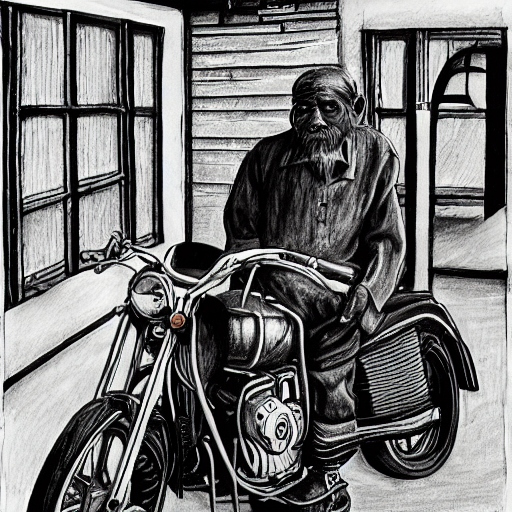
If you were to happen upon the intersection of Ranga Road and West Circular Road in the suburbs of the South Indian city of Chennai on a hot summer afternoon in 2002, you might think something odd was happening. You would come across a group of people staring intently and/or expectantly at an older man in the middle of the street. The crowd would consist of about 20 people, with the average age skewing towards the younger side. The old man wouldn’t have looked like a magician or a singer. He certainly wouldn’t have appeared capable of dancing or performing any acrobatics, even though he would have been standing next to a large motorcycle. So who was this dhoti-clad man, and why was a mob surrounding him?
No one knew when or where Mr. Raju, or Raju uncle as we used to call him, came from. He was about 60-70 years old, wore thick-rimmed aviator-style spectacles, and was usually dressed in a checkered shirt and a crisp white dhoti. His wrinkled face was covered in hundreds of lines, with only a few shiny white strands attempting to conceal his head. He had always been a part of this neighborhood, residing at house number 17 on Ranga Road, directly across from my place of residence. He had been there when my parents purchased a small plot of land on Ranga Road and began building their dream home brick by brick in 1990. He had also been there when my friend Madan’s parents did the same in 1986. According to all accounts, he was the first resident in the area and had always lived alone at house number 17. The small single-story house appeared quite ordinary from the outside, some might even describe it as predominantly brutalist in style. The exterior was painted in a dull gray, with light blue accents around the window sills. The window shutters matched the same blue shade, and the small complex was enclosed by a 5-foot-high brick wall, also painted gray.
I can only describe the exterior of the house to you because I did not know what the interior of the house looked like. In fact, no one who lived in the area knew what it looked like because no one had ever stepped inside of it. It was not for lack of trying though. My father recalls trying to invite him to our house’s grihapravesam (a Hindu ritual performed when moving into a new home), but his invitation was respectfully declined. Similar stories were shared among the families, with invitations to birthdays, funerals, baby showers, Diwali, and others constantly rejected. Eventually, people stopped trying and pretended to ignore the existence of this man. And it seemed like he was perfectly happy with that.
Raju uncle kept his public appearances to a minimum, but he had a consistent and predictable schedule. I would usually see him sitting on a plastic chair under the large tree in his front yard, reading that day’s copy of The Hindu with a glass of coffee in his hand when I went to collect the bags of milk from the milkman at around half past six in the morning. I would regularly pass him on my bicycle on my way to school, close to our neighborhood, during his regular morning walks, with one ear glued to his portable radio tuned to the local AM radio channel. In the evenings, when I played cricket with my friends on the street, I could sometimes hear sounds from the TV inside his house, playing Tamil songs and movies from the 1950s or 1960s. He could sometimes be seen walking to the neighborhood grocery store later in the day to buy produce and milk. And sometimes, he would be spotted carrying a tiny petrol can back and forth from his house to add fuel to his motorcycle.
The motorcycle in question was a shiny, black Yezdi Roadking, year unknown. It was in impeccable condition, with the chrome engine and exhaust tips glistening with pride. No one in the neighborhood had seen Raju uncle ride it even once, but almost everyone who lived there had listened to the noise the loud 2-stroke engine made once a week. That was because he made it a habit to start the motorcycle and let it run for a few minutes every weekend morning. I assumed he suffered from some debilitating condition that prevented him from riding his precious two-wheeler, and he maintained it in good condition by starting it occasionally and cleaning it meticulously because he was emotionally attached to it, unable to let go. But my assumptions were soon proven wrong.
On a fine Saturday morning in the summer of 2002, I was watching The Tom and Jerry Show on TV when the doorbell to our house rang, and I was told to go check who it was. Imagine my surprise when I saw Raju uncle standing near the front door, staring at me sheepishly. I think I might have been staring at him for a few seconds longer than expected because my father had dropped whatever he was doing that morning to check out what I was staring at. If he was shocked, he didn’t show it.
“Sir, please come in,” he invited Raju uncle into the house.
“It’s okay, sir. I just wanted to ask for a small favor,” Raju uncle insisted on standing outside the front door.
“Whatever it is, please come sit inside and have some coffee at our house.” It felt like a genuinely warm invitation.
Raju uncle hesitated for a minute, but eventually relented and came inside. My father asked my mother to make some coffee for our neighbor as he sat down on the sofa in the living room. I ran inside and stood near the door to my bedroom. I was a curious kid, and I was really curious to know what the favor was going to be.
“I want to learn how to ride a motorcycle,” he mentioned after my mother had handed him a glass of coffee. “Do you know anyone who can teach me? I am willing to pay.”
Once again, if my father was surprised, he didn’t show it. I think if I were in his place, I wouldn’t have fared very well in that regard.
“Oh, is that it? I do have a cousin who works at a driving school nearby. His name is Sekar and he usually teaches car driving, but I am sure he would be willing to teach motorcycle riding too. If you are okay with that, I can put you in touch with him,” he offered graciously.
“Yes, that would be perfect. Thank you very much. Please do.” Raju uncle had finished his coffee and stood up to leave. “Thank you again.”
And that was it. Raju uncle didn’t know how to ride, and that was the reason no one had ever seen him ride his Yezdi. My father’s cousin was called, and he agreed to teach our neighbor how to handle a motorcycle for a very nominal amount. The date and time for the first riding class had been decided, and thanks to yours truly, that information was duly shared with all our neighbors. So when the day arrived, a small crowd of mostly kids had gathered near my house to watch Raju uncle ride his motorcycle. Sekar brought the black motorcycle outside the walls of the house for the first time in years and asked Raju uncle to sit on top of it. He was then shown the basic controls, including the foot brake lever, the throttle, the gear lever, and the operation of the clutch, among other things. The motorcycle was kicked into life with sounds that filled the street.
“When I say ‘go’, I want you to change into first gear and slowly release the clutch,” I could hear Sekar trying to shout over the noise the motorcycle was making. “Do not use the throttle yet!”
“Okay!” Raju uncle nodded in agreement.
“Go!”
What happened next was a blur to everyone who was watching the scene unfold. I remember hearing the sound of a motorcycle revving up, and a person wearing a blue checkered shirt and white dhoti performing a full wheelie on a black Yezdi before completely and utterly losing control. When the pandemonium ended, the motorcycle was lying on the ground with its rear wheel still spinning two houses down the street, and Raju uncle leaning against the wall of my house, hands on his nose which was leaking blood profusely. Sekar was the first to react, as he ran to his student, checking for any head injuries and asking him if he was okay. While I was still among those in the crowd reeling from the shock, some were being more proactive. Bandages were brought to the scene, a bottle of water appeared from somewhere, the motorcycle had been made upright again, and an auto-rickshaw had been summoned. Thus, before the dust could settle, Raju uncle had been placed inside the rickshaw and sent to the nearest hospital.
Two days after the incident, some people in the neighborhood reported seeing a young man walking into house number 17 on Ranga Road with a small bag of cash. He shook hands with an older man wearing a checkered shirt, white dhoti, and a distinct white bandage on his nose before riding away from the house on a black Yezdi Roadking. The motorcycle was never seen in the neighborhood again.